
A grieving Nigerian father, Ibrahim Balogun, has opened up on the m8rder of his son in Dublin, Ireland.
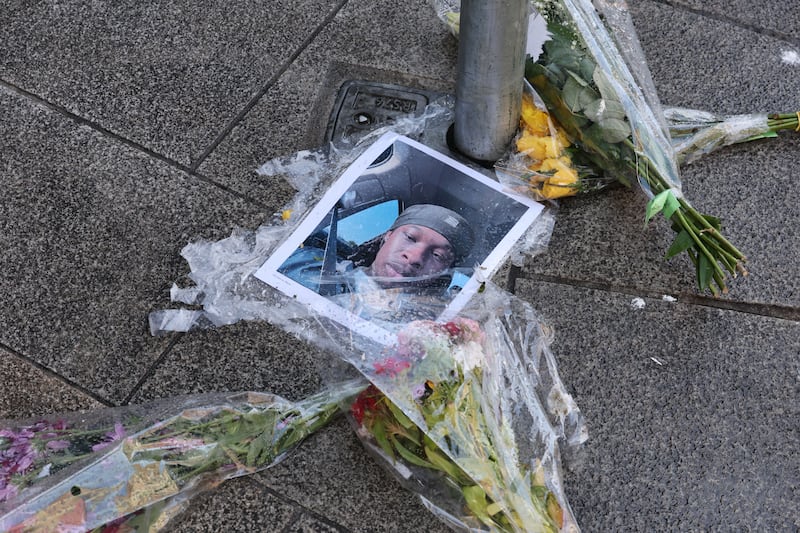
21-year-old Qayyum Balogun d!ed after he was st@bbed three times on Clarendon Street, near Grafton area of Dublin on June 1, 2026.
He had attended a gig at Bewley’s, where he is understood to have attempted to help a woman who was being harassed.
On the night he was k!lled, Qayyum, should have been visiting Nigeria with his father but he had exams.
“It’s hard to believe my son would d!e in Ireland, after what I left in Nigeria,” the distraught father told Irish Independent on Sunday, June 28.
The main suspect, an amateur rapper aged in his early 20s, was captured on camera fleeing the scene of the attack in Dublin city centre before leaving the country later that day.
He also made vile bragging references online afterwards, saying: “Wats a body to me,” and, “Rest in piss.”
Qayyum was laid to rest at Newtown Cross Lawn Cemetery in Drogheda, Louth, on June 16, as dozens of mourners gathered to pay their respects.
The trip to Dublin he and his sister Aliyah (20) planned, was to see Nigerian singer-songwriter Famous Pluto on the June bank holiday weekend, was to be an exciting adventure.
The siblings, who spent most of their lives in Dundalk, finished their summer exams at Maynooth University the previous Friday.
Qayyum was in his third year of a computer science degree. Aliyah studies psychology.
The Sunday night gig at Bewley’s cafe on Grafton Street would not end until after 2am, and there was hope of attending an after-show party, so the siblings booked a hotel in the capital.
Qayyum lived in the Ecco Road area of Dundalk with his father Ibrahim, his stepmother Loveth Patrick, brother Ganiyu (15) and sisters Alimat (17) and Tolu (12).
The children’s mother, Teslimot Balogun, lives nearby in Dundalk with Aliyah.
Sitting in the small front room of the Ecco Road home on Thursday afternoon, Ibrahim, a quality controller at a Co Monaghan food factory, says he was visiting family in Nigeria when he got a call from Aliyah at about 4am on Monday (local time in Nigeria is the same as in Ireland).
“I had my phone beside my bed. When I saw the time I was pretty sure something was wrong,” Ibrahim said.
“She was like: ‘Dad, Dad, Dad.’ I asked: ‘What happened? What happened?”
She told me: ‘Qayyum got st@bbed.’
“I was confused. I was devastated. I had to call [Loveth]. ‘Is Qayyum home?’ I asked. She said he was home, but then she ran to his room, woke his brother, but Qayyum was not home.”
Loveth explains she had left for work, as a supervisor in a local hotel, at 8am on Sunday.
“Qayyum was still sleeping when I was leaving for work because he was working the night before. When I got home at 6pm, I believed he had gone to work,” Loveth said.
Qayyum had a weekend job in Burger King at the Castlebellingham service station on the northbound M1 that runs from Dublin to the Border. It’s about an 11-minute drive from his home. He finished there at about 11.30pm, usually getting home shortly after midnight.
However, he took that Sunday off and travelled to Dublin with Aliyah and friends.
“They went to the concert,” says Ibrahim. About 400 people attended the gig which started at 10.30pm and ended at about 2.30am.
“After the show, he told his sister he wanted to stay out and have more fun, so she went to the hotel,” says Ibrahim.
“They were still on phone, chatting and he told Aliyah: ‘My phone is running down. I am coming soon’
“When he did not return, she tried calling him but could not get through,” says Ibrahim.
One of Qaayum’s friends called her at about 3.30am to tell her he was in an ambulance with her brother on the way to St James’s Hospital.
His family understand he was first attacked on Grafton Street before being pursued along Johnson’s Court beside the venue and on to Clarendon Street where he was fatally st@bbed just before 3am.
Aliyah called both parents as she rushed to the hospital.
“She was ringing me, panicking, at 4am,” says Teslimot.
“I called the hospital. They said: ‘He has gone to theatre, but come down, he needs to see you.’ We had to get a taxi to St James’s. When we got there the doctor said they tried their best to save him. He had multiple stab wounds. He was already d3ad.
“His sister was just beside him saying: ‘Qayyum get up, Qayyum get up.’ When we got home, she couldn’t cry. It was only when some of our friends came she started bursting crying.
“They were so close, you know, because of the [small] age difference. They were best friends. It is a very terrible thing,” says their mother.
Qayyum, the eldest child, was born in the Rotunda Hospital, Dublin, in September 2004.
His parents came from Nigeria in the early 2000s and were granted refugee status.
They lived in the Drogheda area before moving to Dundalk when Qayyum was a boy. He went to primary school there, attended Ó Fiaich College secondary school and the Ó Fiaich Institute of Further Education before going on to university.
He had been in Nigeria a number of times.
“He had a nice time last time he went in 2023,” says Ibrahim.
“He was going to come with me on this visit, but he had exams. He was looking forward to being a computer engineer. He wanted to make websites.”
Asked about reports that his son was a music promoter, he said;
“No. He didn’t even have a speaker, not a microphone. He was a full-time student. He loved American rap, African music, but just to listened to,” says Ibrahim.
“He was a gentle soul,” says his mother. “Qayyum was sweet, very sweet. He didn’t go out at night. He loved his brother and sisters. He went to school, home, eat, go to his room.
“I was always saying, ‘Go out. Go out, have fun.’ He said: ‘I am fine. I am fine.’ He’d just play with his PlayStation in the house.”
A family friend from Drogheda, Tosin Adeyemi, recalls Qayyum visiting her home as a child.
“I always call him ‘Qayyum-baby’ because every time he comes to my house he sucks his thumb. He was so shy and smiling,” Tosin says.
“Hearing he was attacked like this, it is so sad. He was just going out after exams to have fun. This should not be happening.”
Asked how they are, his parents say they are “just coping”.
“I am still in shock,” says Ibrahim. “It is very difficult to believe this is happening. I find it difficult to believe I will not see him any more. There is a lifetime of pain.”
His mother says she thinks about how much pain Qayyum was in as he d!ed.
“He d!ed a miserable d8ath. He was quiet, he didn’t like trouble – always going his own way. No one deserves to d!e like this. The pain and the hurt is very, very deep,” she says.
Speaking directly to the suspect, Mr Balogun added: “Your picture has come to light, showing you holding a knife — you should come home and explain it.”
Mr Balogun told how the picture of the man with the weapon in his hand has compounded his grief.
“I felt great pain, like for someone running on the street with a knife, with that audacity. It is not a toy, you shouldn’t be doing that,” he said.
“I’m extremely angry with that picture, to be honest with you. I’m really, really extremely angry, above everything else.
“We want to know the truth — we want to know what prompted the attack.”